
Investing heavily in search engine optimisation (SEO) feels like the right move for growing your business. But what if the user experience your website provides actively prevents you from capturing high-intent search traffic?
Many businesses fall into the trap of optimising pages that have little chance of driving meaningful revenue because they fail to deliver the experience modern buyers demand. If your search strategy isn’t aligned with both search engine layout realities and customer expectations, even a top rank won’t save your bottom line.
Here is how one industrial business confronted this challenge, shifted its go-to-market strategy, and transformed its digital footprint.
The Reality Check: An Industrial Case Study
My client is a US-based supplier and maintenance service provider of industrial air compressors and other automation equipment. Historically, the company relied on a traditional sales model. Aside from a basic “line card” listing the brands they carried, their website hid virtually all product details. To find out what models were offered, let alone how much they cost, customers were forced to contact a sales representative via a form or the sales line.
As part of the project kick-off, I evaluated the search engine results pages (SERPs) for their target commercial keywords geared around air compressor makes, models and sizes. This is when a clear mismatch emerged between their site structure and the search landscape: The search results prioritised an eCommerce user experience, something my client could not compete with.
Here is an example of a typical above-the-fold experience in Google for the kinds keywords this business is targeting in the US:
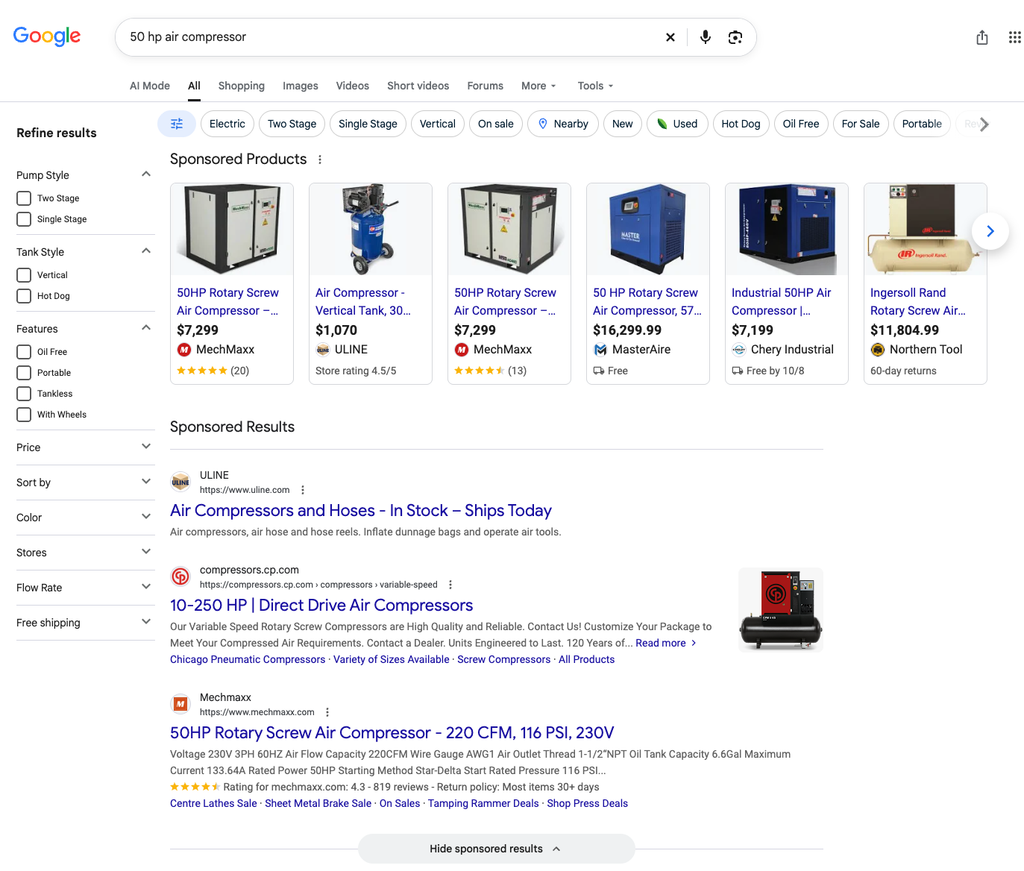
As we can see, the entire above-the-fold area is covered by sponsored products and ads.
Moving further down, we see the popular products carousel dominating, which retailers can appear in for free by providing a product feed in Google Merchant Center:
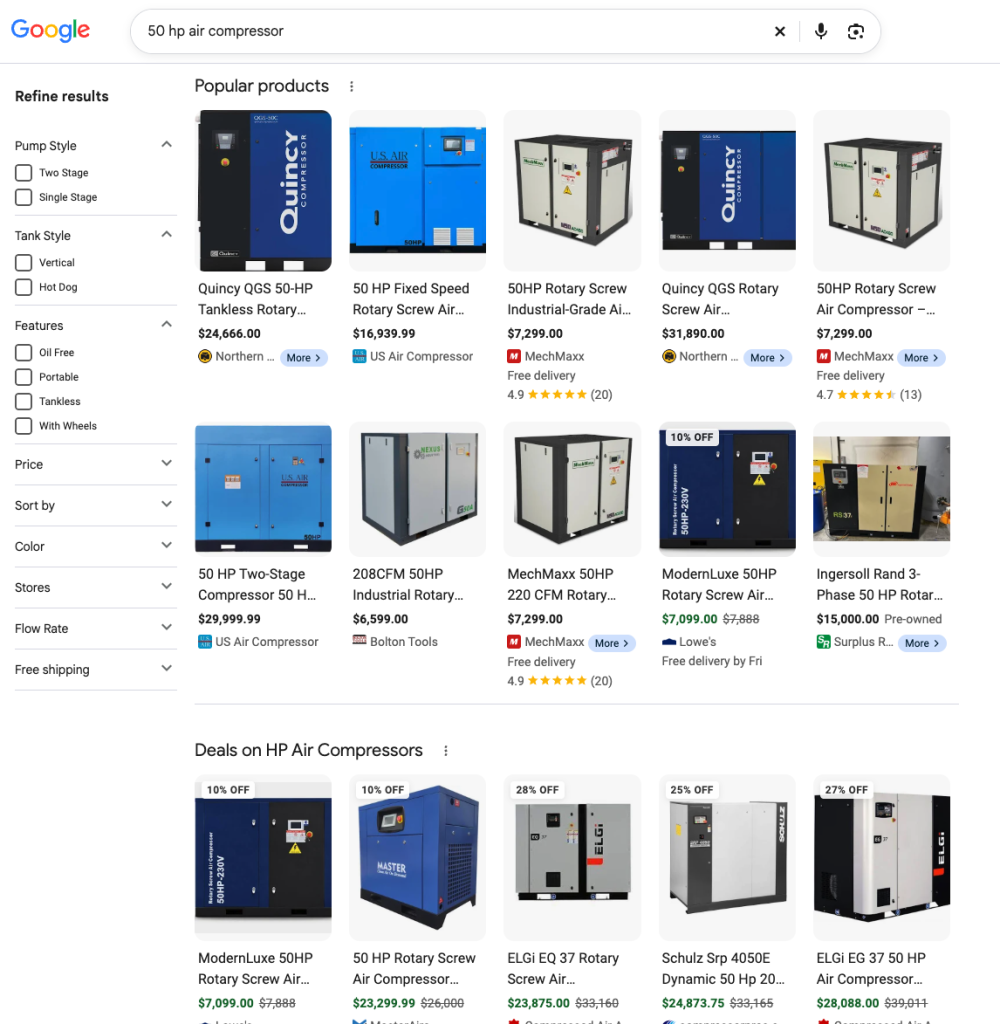
Only then, a further few scrolls, do we reach the “traditional” organic search results, where non-product content can appear organically.
Under their existing website model, the company could only compete in traditional organic search results, as they had no eligible product pages that could show up in product carousels. That placed them several scrolls down the page, completely locked out of the prominent product carousels dominating the above-the-fold space.
Because click-through rates (CTR) decay exponentially as users scroll, even a #1-3 position in traditional organic search might yield as little as a 1% CTR when competing against dynamic product displays and ads above it.
The Shift in B2B Buyer Expectations
Beyond the SEO disadvantages, the legacy approach created friction for modern buyers. Competitors were providing transparent pricing and instant online ordering options.
Faced with two options, a supplier that provides transparent product data up front, or one that forces you to fill out a contact form just to get basic details, buyers would be likely to choose the path of least resistance.
Nobody wants to hand over contact information and risk a high-pressure sales call just to get fundamental product specs.
This behaviour reflects a broader market shift. As research from McKinsey & Company highlights:
“More than a decade ago, McKinsey research highlighted a major change in how business customers behave: B2B buyers were beginning to act more like consumers, expecting greater transparency, faster responses, and the ability to research and compare suppliers. A second inflection point came during the COVID-19 pandemic, when travel restrictions and remote work forced organisations to adopt new digital and self-service channels at unprecedented speed.”
Overcoming Skepticism: “Who Buys $100,000 Industrial Equipment online?”
Internal stakeholders were initially skeptical. The dominant objection was understandable: Who is going to buy a $10,000 or $100,000 industrial piece of machinery using a credit card on a website?
While high-ticket B2B sales often require human touchpoints, that doesn’t invalidate the need for an eCommerce digital experience:
- SERP Visibility is Non-Negotiable: Google is serving product carousels for these high-ticket terms regardless of price point. Having structured, individual product pages is a prerequisite to even compete above the fold. My client would not even be on the playing field without eligible product pages.
- Product Pages as Rich Landing Pages: It’s true that not all customers may be willing to purchase online. However, as a bare minimum, product pages bring customers one stage closer to a sale by providing transparent product information instead of gatekeeping it behind the sales team. Buyers can land on a detailed page, evaluate specs, and compare against other vendors without friction. When they are ready to reach out via phone or form, they do so as far more qualified, high-intent leads.
This approach is the same as in high-ticket B2C eCommerce businesses that also run bricks-and-mortar branches, such as jewelry, which I previously worked in. We knew that many customers would prefer to visit in-branch to try on that luxury watch they coveted. However, consumers need to be convinced to make the trip as opposed to visiting a competitor. Product pages achieve this by clearly showing the price and in-store availability alongside catering for the primary eCommerce user journey.
The Solution: A Collaborative Digital Transformation
Recognising that this was not just an SEO issue but a fundamental business imperative increasingly highlighted by investors, the business initiated a comprehensive eCommerce transformation to future-proof its operations.
To execute this vision, the company built a cross-functional team combining internal operational leadership with specialised external expertise:
- Internal Capabilities: Hired an internal project manager to handle warehousing operational changes, inventory management systems, and core product data integration.
- SEO & Digital Strategy: Partnered with Atkinson Smith Digital, working alongside their broader digital agency, to guide site architecture, technical SEO, and search positioning.
The company is now actively rolling out the first iteration of its eCommerce platform to help open up above-the-fold SERP visibility, meeting B2B buyers on their terms, and positioning the business for sustainable digital growth.
Key Takeaway for Marketers and Executives
Introducing an eCommerce solution is a bold move and affects the whole organisation, not just the website. However, not embarking on this project risked the business fighting for an ever-declining share of the pie, not just in terms of diminishing available real-estate in search engines results pages, but also by offering an outdated and increasingly unfamiliar experience to modern B2B buyers who expect B2C levels of convenience and lack of friction.
There will always be voices within businesses that put their faith in old methods that always used to work. But it’s important to remember that customer expectations are a moving target. Businesses do not exist in a vacuum and must adapt to changing market demands, whether that’s through customer research, competitor analysis, or being aware of the kinds of customer experiences that Google is prioritising in search.